Supporting Overseas Trained Teachers to flourish in Aotearoa
Nau mai ngā maunga whakahī,
ngā moana whakatere,
me ngā waka o ngā tōpito o te ao.
Tuia ki runga,
tuia ki raro,
tuia ki waho,
tuia ki roto,
tuia ngā here tāngata.
Ka rongo te pō, ka rongo te ao.
Tīhei, mauri ora.
Across our early learning centres, primary learning environments, and secondary schools, stepping into the role of a mentor teacher is both a genuine privilege and a delicate balancing act. Grounded in the spirit of tuakana-teina, effective mentoring in Aotearoa is a reciprocal relationship of ako where listening, learning, and growing flow mutually between mentor and mentee.
This shared journey takes on even deeper significance when welcoming overseas-trained colleagues. Moving to a new country to teach is about much more than adapting to a new curriculum; it’s about finding a sense of place and belonging. Let’s consider what it looks like to move beyond expert-led induction to honouring identity, sharing local stories, and practising genuine reciprocal learning (ako) alongside overseas-trained colleagues.
Nā tō rourou, nā taku rourou, ka ora ai te iwi
With your food basket and my food basket, the people will thrive
This whakataukī speaks directly to the power of combining diverse contributions. It reminds us that sharing our unique cultural perspectives, skills, and knowledge enriches our relationships and is essential for our collective growth and success in Aotearoa New Zealand.
Many overseas trained teachers (OTTs) arrive in Aotearoa with significant professional experience, pedagogical expertise, unique cultural values, languages and identities, and a commitment to making a difference for learners. Yet experienced OTTs can find themselves navigating unfamiliar terminology, systems, expectations, and cultural contexts.
“I asked a new OTT why they weren’t attending staff hui – no-one had told them what a ‘hui’ was!”
Success for OTTs is rarely about becoming a different teacher. It is more often about understanding a new place, building relationships, and learning how education is shaped by the unique histories, cultures, and communities of Aotearoa New Zealand.
Our role as mentors is not to teach OTTs "how to be a teacher." Our role is to create the conditions where their experience is acknowledged and developed, allowing them to flourish as both people and practitioners in Aotearoa.
Mentoring through the lens of the pā harakeke

In te ao Māori, the pā harakeke (flax bush) is a metaphor for thriving whānau.
The rito, the young shoot, is at the centre and is nurtured and protected by the surrounding awhi rito and tīpuna. Each part of the plant sustains the wellbeing of the whole. No leaf stands alone.
Understood through the metaphor of the pā harakeke, mentoring becomes more than supporting individual teachers. It is about nurturing the conditions in which the whole community can thrive.
The metaphor of pā harakeke aligns closely with Te Tiriti o Waitangi. Both invite us to think relationally, honour the mana and contributions of others, and recognise that our wellbeing is interconnected. When OTTs experience such relationships, they encounter Te Tiriti o Waitangi both as something to learn about and something that is lived. Upholding the mana and rangatiratanga of OTTs supports their induction into a new education system and models what Treaty-based relationships look and feel like in practice.

How does your mentoring approach support OTTs to encounter Te Tiriti o Waitangi not simply as something to learn about, but as something that is lived?
Kia mahi tahi tāua?
Exploring identity through manaakitanga
Before you can understand someone as a teacher, you first need to understand who they are as a person. If I asked you to show me who you are beyond your CV, what would you bring to the table? A photograph? A favourite book? A gift from home? A taonga?

Photo via Flickr by Anne Robertson CC-BY
I often share my mother's old jewellery box. Inside sits a collection of objects with little financial value, but immense sentimental worth: an old winding watch of my grandmother’s that still ticks, photos, and keepsakes that connect me to the people who shaped me. The box doesn’t explain my teaching practice, but it tells a story about who I am.
Sharing kōrero tuakiri
In te ao Māori, people introduce themselves through pepeha, connecting identity to their mountains, waters, and ancestors. A pepeha doesn't have to follow a rigid script. The power lies in the storytelling.
Here is how I share my journey as tangata tiriti:
I tipu au i Leeds, tētahi taone nui i te raki o Ingarangi. I was born in Leeds, a large town in the north of England.
I introduce my parents, my sisters and my immediate family – Ko Shelagh rāua ko Norman ōku mātua. Tokotoru aku teina, ko Kate, rātou ko Jo, ko Stephanie. Ko Nigel taku tane. Tokorua aku tama, ko Lachlan rāua ko Aonghas.
Ko Ingleborough te maunga e rū nei tōku ngākau. Ingleborough in the Yorkshire Dales is a mountain that speaks to my heart – it is where I met my husband and we raised our boys.
Engari, ko Waikato te awa e mau mai ai taku kaha ināianei. Now I live in Kirikiriroa Hamilton, drawing strength from the Waikato river beside me.
Ko Te Tiriti o Waitangi te waka e ārahi ana i au ki kōnei i Aotearoa. Te Tiriti is the waka that enables me to be here as an immigrant and guides my place in this country.

Image created by Anne-Louise Robertson via Flickr CC-BY
Background photo of Te Tiriti o Waitangi from: https://en.wikipedia.org/wiki/Treaty_of_Waitangi#/media/File:Treatyofwaitangi.jpg. Public Domain

When you invite OTTs to share their kōrero tuakiri, whether through identity maps, pepeha, photo stories, or cultural keepsakes, you shift from gathering information to practising mana-enhancing mentorship. You are acknowledging their identity, culture, and lived experience.
The strength of a pepeha comes from the heart of its message: revealing who you are, where you belong, and making connections. My own pepeha combines te reo Māori and English, paired with a photo collage to bring it to life. For OTTs, blending their native language with English can be a powerful way to honour their roots.
Creative ways to tell your kōrero tuakiri:
- Photo stories and identity maps
- Meaningful objects or taonga
- Places that hold special meaning
- A list of "key moments that led me to teaching"
- Significant family, community, or cultural narratives
Think for a moment about what you can do to share identity stories and acknowledge who your mentee is.
Kia mahi tahi tātou?
Building relationships and supporting rangatiratanga
Belonging doesn't happen in isolation within four classroom walls. OTTs consistently tell us that settling into Aotearoa is strengthened through meaningful relationships and involvement in local life, whether that's through sports clubs, music groups, local events, churches, or other social networks.
As mentors, our job is to listen to their identity stories and help them forge connections with spaces outside of school where they can make a home.
Shifting from being the expert to ako: reciprocal learning
One of the greatest risks in mentoring is unintentionally positioning ourselves as the absolute expert and the newcomer as the learner.
Rangatiratanga (self-determination and leadership) challenges this power dynamic. It asks us: How do we create a partnership where both people bring authority, knowledge, and agency?
Conceptually, this is ako; the reciprocal relationship where the teacher learns and the learner teaches. To make rangatiratanga visible in your daily conversations, reflect on your language choices:
|
Instead of Saying... |
Shift Your Language To... |
|
"Here’s how we do things here." |
"How was this approach managed in your previous school?" |
|
"Let me show you the best way to do this." |
"What expertise could you bring to this situation?" |
|
"What support do you need from me?" |
"What would success look like for you in this space?" |
|
"Here is your set induction programme." |
"Which parts of settling in feel most important to you right now?" |
Try asking yourself this week: What is something my mentee knows that I don't? When was the last time they taught me something new? When did I ask them for advice?
Nō hea tātou? Kei hea tātou?
Understanding place and language
"What this place is and what happened here not only tells the journey and settlement of the area, it also reveals how best to partner with the place and realise the potential of all who live here."
Phoebe Davis
Ko Ngati Manu, Kohatutaka me Ngai Tamahaua ngā hapū
Ko Ngāpuhi me Te Whakatohea ngā iwi
He kaiako, he Ringa Raupā mō te hapū
Once we understand each other's stories, we can begin to unpack the place where we currently stand.
Cultural literacy in Aotearoa isn't about memorising facts; it's about connecting to the whenua | land, iwi, marae, and kōrero tuku iho │ traditional knowledge. Māori place names act as oral maps. For instance, Tāmaki Makaurau│Auckland translates to "Tāmaki of many lovers"; a name reflecting how its volcanic soil and waterways made it a highly prized region contested by many iwi. Sharing these historical contexts transforms local geography into meaningful cultural understanding.
What do you know about the stories of your place? It’s ok if you don’t know because that provides a good opportunity to learn alongside your mentee.
Navigating the linguistic landscape
Aotearoa is linguistically complex for newcomers. Even native English speakers from overseas are often overwhelmed by the blend of te reo Māori, regional slang, educational jargon, and everyday Kiwi expressions.
English phrases like "bring a plate", "jandals", or "togs" can cause quiet confusion if left unexplained. Then we pepper our conversations with a multitude of kupu Māori such as “kura”, “whānau”, “ako”, “ākonga”, “kaiako”, “mahi”, and “hui”. On top of that, there’s education jargon and acronyms which can feel overwhelming.
Understanding the vocabulary matters, but the deeper learning comes from understanding the ideas and values behind the words. Many Māori concepts used in education reflect relational ways of thinking and learning. They offer insights into how communities, identity, and learning are understood within Aotearoa.
Practical ways to support language and belonging:
- Create a shared glossary of school-wide and national educational acronyms
- Share the local context behind words naturally embedded in New Zealand English
- Model speaking te reo Māori in your daily context
- Create a low-stakes environment where asking, "What does that word mean?" is welcome and normalised
- Learn alongside your mentee
Reflecting on practice
Let's return to the metaphor of the pā harakeke.
Your overseas trained colleague arrives at your school with existing strengths, rich professional wisdom, and immense personal courage. They do not need to be reshaped; they need to be given space to thrive.
How will you walk alongside your overseas trained colleagues this term to help them deepen their roots and flourish, as both a teacher and a person, here in Aotearoa?
Glossary
|
ako |
Reciprocal teaching and learning. |
manaakitanga |
Caring for others; showing respect, generosity |
|
ākonga |
Learner, student. |
marae |
A Māori meeting place and focal point |
|
awhi rito |
The two leaves on either side of the the central shoot of the harakeke plant |
pā harakeke |
A flax bush or flax grove, - a metaphor for whānau and collective wellbeing. |
|
hui |
Gathering, meeting |
pepeha |
A way of introducing oneself through connections to people, places |
|
iIwi |
Tribe; a large kinship group |
rangatiratanga |
Leadership, self-determination, autonomy |
|
kaiako |
Teacher, educator |
rito |
The central young shoot of the harakeke plant. |
|
kōrero tuakiri |
Identity stories; sharing narratives about who we are, where we come from |
taonga |
Treasure or something highly valued. Can be tangible or intangible |
|
kōrero tuku iho |
Stories, histories, etc handed down through generations |
tīpuna |
Ancestors |
|
kura |
School, learning place |
tuakana-teina |
A reciprocal relationship where a more experienced person (tuakana) supports a less experienced person (teina) |
|
mahi |
Work, activity, task |
whānau |
Extended family |
|
mana |
Prestige, authority, influence |
whanaungatanga |
Building and maintaining relationship |
Further support
Strengthening your mentoring practice is ongoing, relational work that evolves alongside the needs of your Pia | mentee and your own growth as a leader. To support you on this journey, the Teaching Council of Aotearoa New Zealand provides comprehensive Guidelines for creating an induction and mentoring programme, offering a clear framework for high-quality practice across our sector.
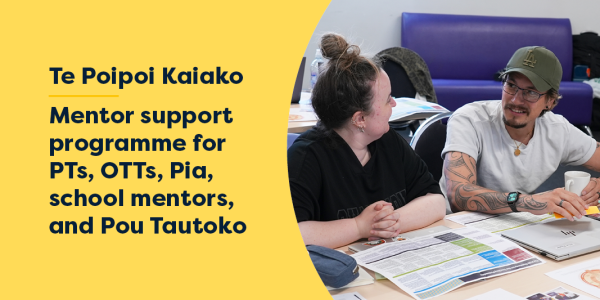
To help you bring these guidelines to life, our Ministry-funded Te Poipoi Kaiako | Mentor Support Programme offers practical workshops and resources designed specifically for both new and experienced mentors. Te Poipoi Kaiako offers:
- Practical guidance – structured frameworks to keep your catch-ups focused, efficient, and student-centred.
- Reflective coaching tools – targeted prompts to develop critical inquiry skills without adding to your cognitive load.
- Professional growth pathways – actionable strategies to help you co-design induction goals and gather meaningful evidence together.
Whether you choose to explore these tools alongside your Pia | mentee or use them independently to refine your practice, we are here to support your journey.
Explore our free resources and learn more about Te Poipoi Kaiako – Mentor Support Programme today.
Share this blog with your peers
